
Lire avec l'IA
If your pages aren’t being found, your best content is invisible.
This guide shows exactly how to improve SEO by fixing what blocks crawling, aligning pages to search intent, and proving wins with measurable KPIs—so you can turn organic visibility into qualified traffic and conversions.
Start with a full-site view using your SEO growth hub so every change ships in the right order.
Prerequisites: what to set up before you optimize
Before any optimization, make sure you can measure outcomes and diagnose failures quickly. At minimum, you want verified access to your analytics and webmaster tools, and a repeatable workflow that doesn’t depend on guesswork. Pour aller plus loin, consultez outils seo gratuits en ligne. À lire également : Génération d’articles IA — Création de contenu optimisé SEO. Ressource complémentaire recommandée : Canonical — Éviter le contenu dupliqué.
- Google Search Console for indexing, queries, and coverage signals (Google Search Central).
- Analytics (GA4 or equivalent) for conversions and landing-page performance.
- Performance testing with Lighthouse/PageSpeed (Chrome Developers).
- Crawl tooling (crawler + server log access) to validate bot behavior.
- CMS + hosting access (templates, redirects, headers, robots rules).
Estimated effort: expect days to diagnose and weeks to iterate, depending on site size and release cadence. Difficulty rises sharply when you lack log access, have fragile CMS templates, or rely on third-party “one-click” fixes. Lecture complémentaire : Inbox — Recommandations IA avec application en un clic. Ressource complémentaire recommandée : Schema — Données structurées JSON-LD pour les résultats enrichis.
Checklist: technical conditions before you start
# Pre-flight technical checklist
- HTTPS enforced, one canonical hostname (www OR non-www)
- XML sitemap(s) accessible and up to date
- robots.txt present, intentional, and not blocking key paths
- Consistent canonical tags on indexable URLs
- 301 redirects for retired URLs (no chains)
- Mobile rendering verified on core templates
- Analytics + Search Console tracking validated
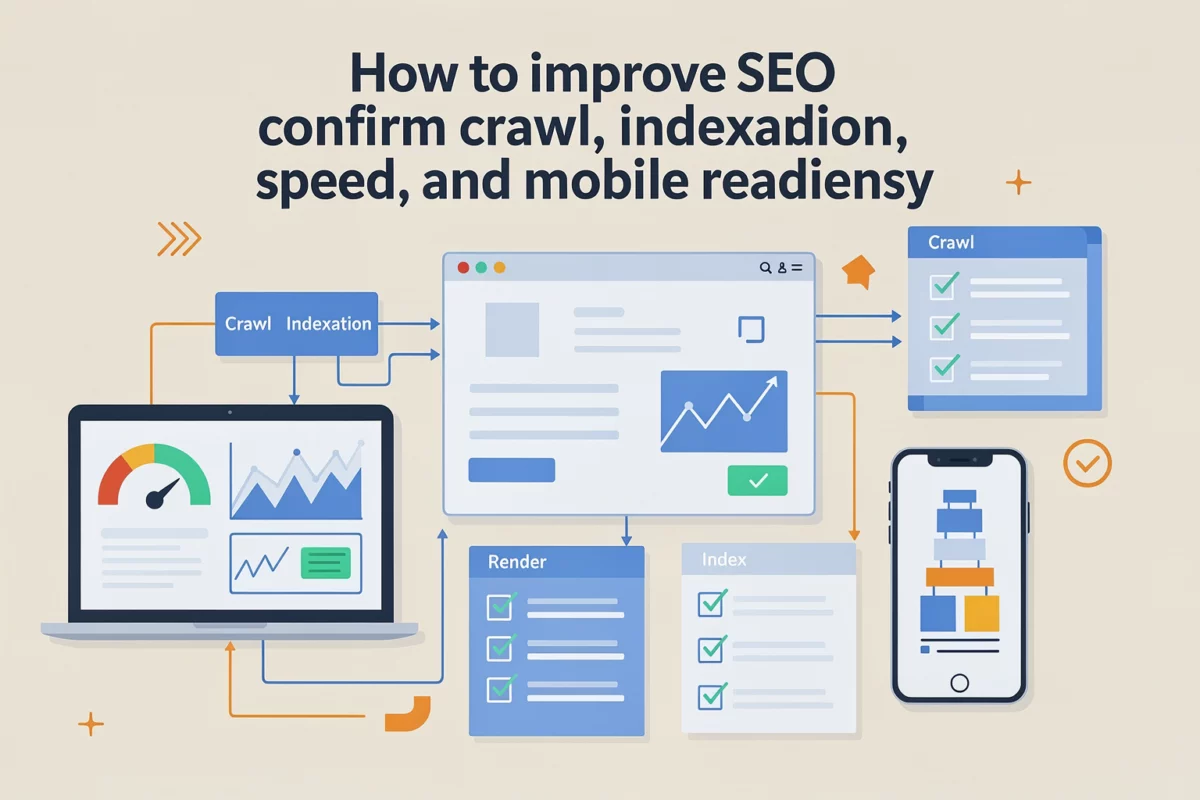
Technical SEO audit: confirm crawl, indexation, speed, and mobile readiness
Improving SEO starts with removing friction for crawlers and users. First, confirm that important pages can be discovered, rendered, and indexed—then validate performance and mobile behavior against real templates and server responses. For crawl and indexing fundamentals, align your checks with official guidance on crawling and indexing behavior from Google Search Central.
What to measure (in priority order)
- Indexation: which URLs are indexed vs. excluded, and why.
- Rendering: JavaScript/CSS delivery, blocked resources, layout shifts.
- Performance: slow templates, heavy scripts, caching gaps (PageSpeed Insights).
- Mobile: navigation, content parity, tap targets, viewport issues.
- Logs: confirm bot crawl frequency, wasted crawl on duplicates, error hotspots.
Diagram: audit funnel, prioritization, and action plan
Flux : [Collect signals: GSC + crawl + logs + speed] → [Classify issues: block / waste / relevance] → [Prioritize: impact × effort] → [Ship fixes] → [Validate: index + rankings + conversions]
Snippet: essential crawl controls (fast verification list)
# Crawl essentials (must-pass)
1) robots.txt: no accidental disallow on money pages
2) HTTP status: 200 for canonical pages; 301 for moved; avoid 302 unless intentional
3) Canonicals: self-referential on indexable pages; not pointing to non-equivalents
4) Sitemaps: only canonical URLs; returns 200; submitted in Search Console
5) Facets/search pages: controlled with noindex/canonical/parameter handling
6) Duplicate variants: normalize trailing slash, case, parameters, and pagination strategy
Practical tip: treat “index bloat” as a tax on the whole site. If crawlers spend time on duplicates, they spend less time discovering and refreshing pages that should rank.
Site architecture and URL optimization for clarity and internal equity
Architecture is how you teach a search engine which pages matter and how topics relate. Your goal is a shallow, predictable structure: category → subcategory → detail pages, supported by internal linking that uses descriptive anchors without becoming repetitive.
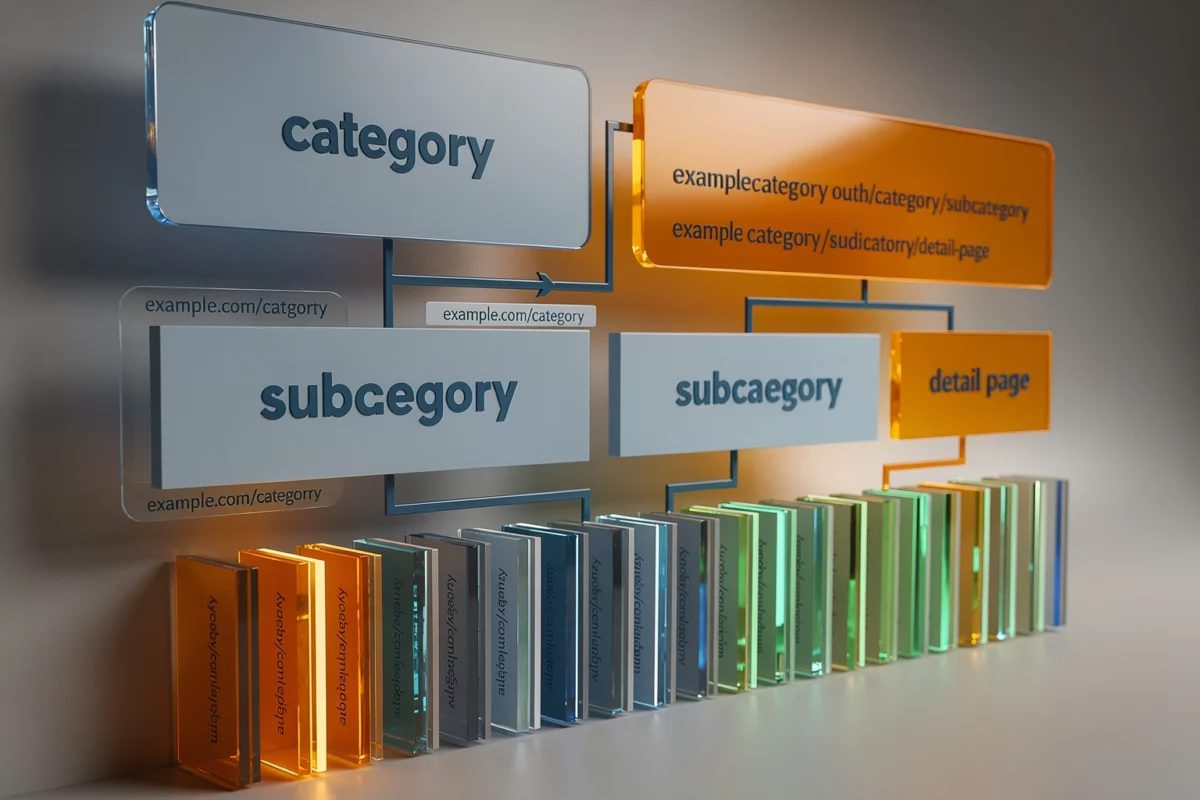
- Category design: one primary intent per category page, not a dumping ground.
- Internal linking: link from hubs to spokes and back to reinforce topical clusters.
- Anchors: descriptive and varied; avoid forcing exact-match everywhere.
- URL hygiene: readable slugs, stable paths, and consistent rules for parameters.
- Navigation: ensure key pages are reachable without search-in-site dependency.
Watch-outs: duplication, pagination, and canonicals
Common failure modes include duplicate category filters, infinite URL combinations, and “canonical to the wrong page” mistakes. Use canonical tags only when pages are truly equivalent, and ensure pagination is handled consistently (don’t accidentally canonical every paginated page to page one if it hides discoverable items). When in doubt, cross-check with Google’s crawling/indexing documentation to avoid rules that block discovery (Robots.txt guidance).
Snippet: optimized breadcrumb pattern (with structured data)
Content and search intent: build pages that deserve to rank
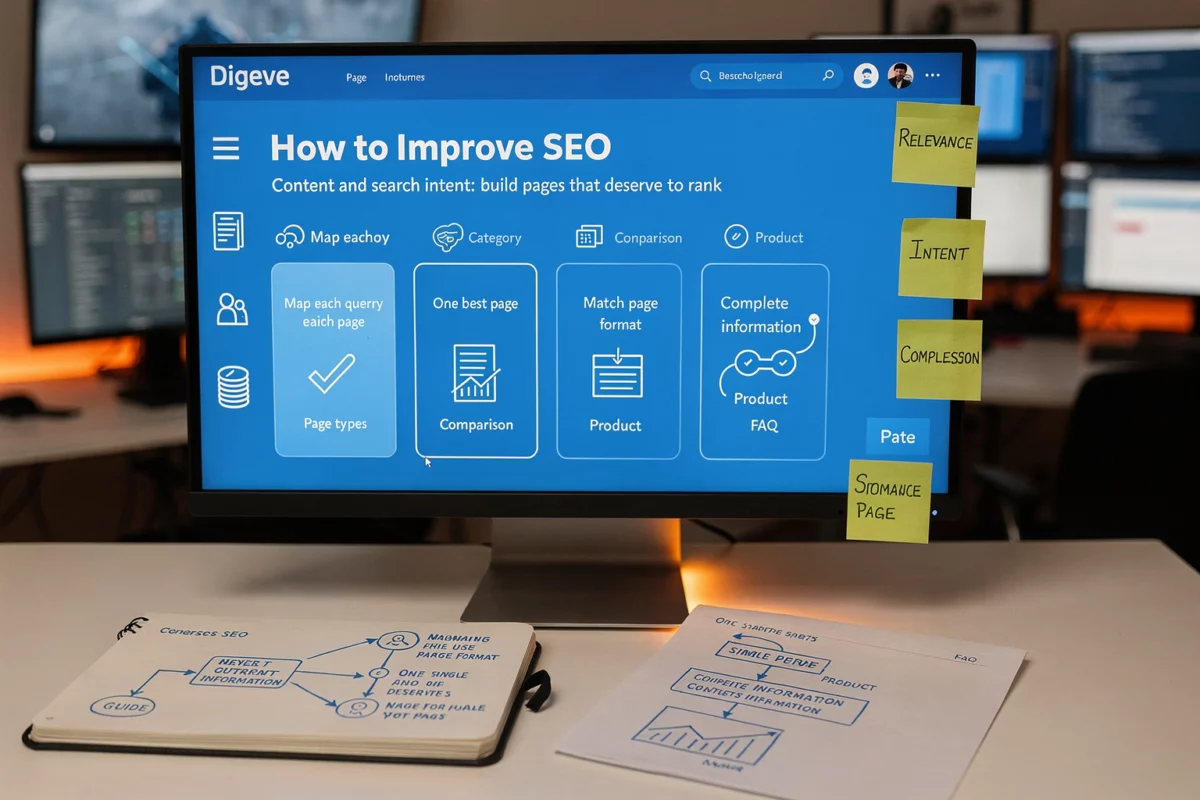
Rankings follow relevance. To improve SEO, map each query to a single best page, align the page format to intent (guide, category, comparison, product, FAQ), and make the information complete enough that users don’t bounce back to results. This is where content quality intersects with behavioral signals and long-term trust.
Intent mapping workflow (simple, scalable)
- Collect queries: from Search Console, internal search, and customer questions.
- Group by intent: informational, commercial, transactional, navigational.
- Assign a primary page: one query cluster → one canonical target URL.
- Define “winning format”: depth, visuals, examples, FAQs, tools.
- Ship updates: refresh headings, sections, and internal links.
Watch-outs: over-optimization and cannibalization
Overuse of repeated phrases can reduce readability and dilute topical clarity. Cannibalization happens when multiple pages target the same intent and compete; fix it by consolidating pages, clarifying canonicals, and updating internal links so one page is the clear “answer.” If you’re doing technical search engine optimization while simultaneously rewriting core pages, stage changes so you can attribute gains and avoid noisy data.
Snippet: title, meta description, and Hn templates
# Title tag (pattern)
Primary Topic – Outcome or Differentiator | Brand

# Meta description (pattern)
Benefit + proof point + what’s inside + qualifier (who it’s for). Keep it human.

# Headings (pattern)
H1: Primary Topic (clear promise)
H2: Key subtopic aligned to intent
H2: Proof / examples / process
H2: FAQs or comparisons
H3: Steps, checks, edge cases
Editorial note: borrowing credible structure from a magazine or a research magazine can help you design scannable sections, but your page still needs original analysis, examples, and updated guidance. If you publish data sheets, ensure they have unique summaries and contextual explanations rather than thin, repeated boilerplate.
One real-world example: a student organization site in Michigan can win with “local + intent” pages if each page answers a specific need (events, membership, resources) and avoids duplicating the same copy across subpages. Don’t treat SEO as science-fiction; treat it like science—hypothesize, test, measure, iterate.
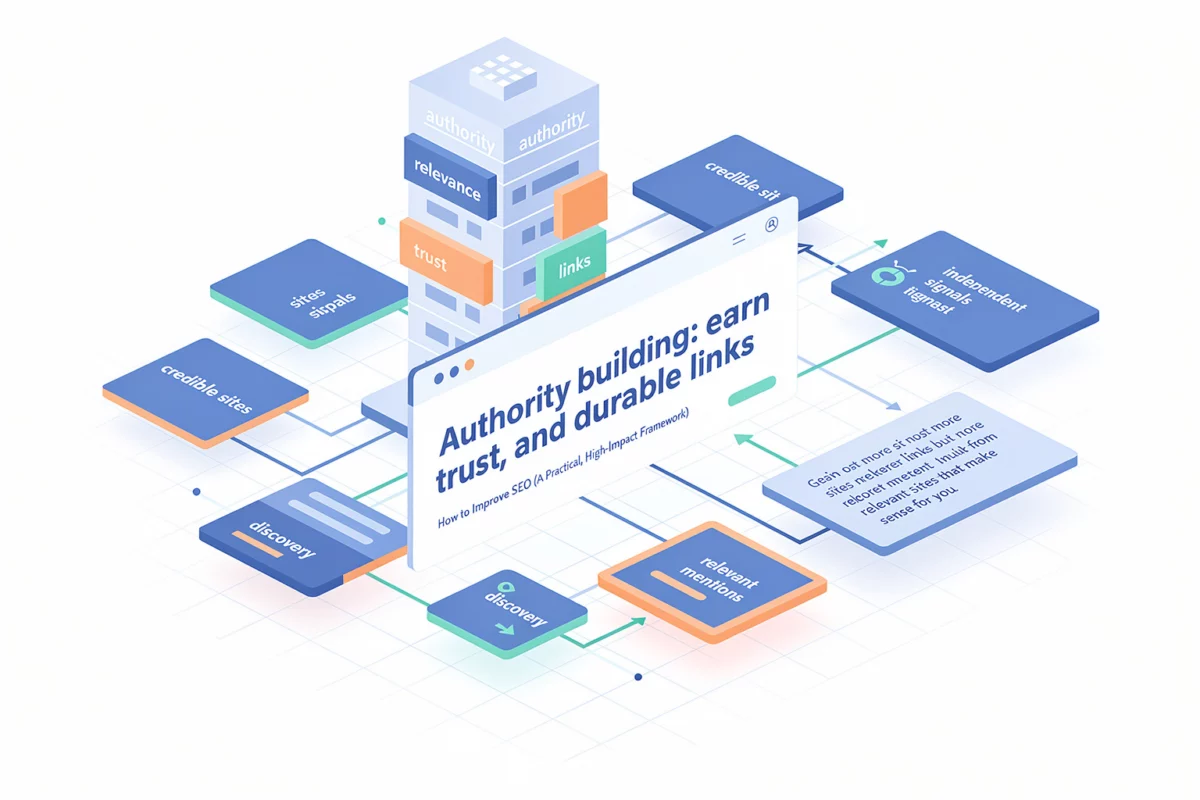
Authority building: earn relevance, trust, and durable links
Links still matter because they act as independent signals of credibility and discovery. The goal is not “more links,” but more relevant mentions from sites that make sense for your topic and audience—earned through partnerships, original research, and useful assets.
- Editorial partnerships: co-authored resources, interviews, expert roundups.
- Linkable assets: calculators, benchmarks, original datasets, how-to assets.
- Digital PR: newsworthy angles tied to real utility (not gimmicks).
- Unlinked mentions: request attribution when you’re cited without a link.
- Local relevance: associations, chambers, universities, and community orgs.
Watch-outs: toxic links and anchor risk
Avoid buying links, automated placements, or unnatural anchor patterns. Keep anchors mostly branded or descriptive; reserve exact-match anchors for genuinely natural contexts. If you suspect risky patterns, audit backlinks and disavow only when there’s a clear, documented reason to do so.
Diagram: link sources that tend to build authority
Flux : [Original asset] → [Outreach to relevant publishers] → [Editorial coverage + citations] → [Referral traffic + links] → [Stronger domain trust]
Bonus lever: strengthen on-site trust signals (clear authorship, editorial policy, contact info, corrections) so new visitors feel safe engaging—especially if you offer services print, handle relations social, or host downloadable resources logos for partners.
Validate results: measure rankings, clicks, conversions, and indexation
SEO improvements are only real if they show up in outcomes. Validate at three levels: (1) technical signals (indexing/crawl), (2) visibility (impressions/positions), and (3) business impact (leads, revenue, sign-ups). Use Google Search Console performance reporting as your primary organic visibility dataset (Google Search Central).
Matrix: common symptoms → fast fixes
| Symptom you observe | Likely cause | Fast correction | How to validate |
|---|---|---|---|
| Pages not indexed | Blocked, thin, duplicate, or weak internal discovery | Fix robots/canonicals, strengthen internal links, improve page usefulness | GSC indexing status + fresh crawl |
| Traffic drop after URL changes | Missing/incorrect redirects, canonical mismatch | Implement 301 map, remove chains, re-check canonicals | Crawl status codes + GSC coverage |
| High impressions, low CTR | Weak titles/metas, mismatch with intent | Rewrite snippets to match intent and differentiate | GSC query/page CTR trends |
| Rankings stuck despite updates | Cannibalization or weak authority signals | Consolidate pages, improve internal linking, earn relevant mentions | Page-level query overlap review |
| Slow pages, higher bounce | Heavy JS, poor caching, unoptimized media | Reduce script cost, optimize images, improve caching | Lighthouse + real-user monitoring |
Snippet: weekly KPI dashboard (simple and repeatable)
# Weekly SEO KPI dashboard (track MoM and WoW deltas)
- Indexed pages: count + notable exclusions (GSC)
- Impressions + clicks: top pages + top queries (GSC)
- CTR: brand vs non-brand segments
- Average position: by cluster (not sitewide vanity)
- Conversions from organic: leads/sales/sign-ups (Analytics)
- Technical health: errors, redirect chains, slow templates (crawl + speed)
Execution rule: change fewer things per release, but validate more carefully—otherwise you’ll never know which fix created the lift (or the regression).
FAQ: key SEO questions that decide your roadmap
How long does SEO take to show results (2 weeks vs 3 months)?
It depends on crawl frequency, site authority, and the size of the change. Technical fixes that remove blocking issues can show movement sooner, while content and authority improvements usually compound over longer cycles. Track leading indicators (indexation, impressions, CTR) before you expect consistent conversion lifts.
What technical priorities help crawling fastest (same-day fixes)?
Start with anything that prevents discovery or wastes crawl: incorrect robots rules, broken status codes, redirect chains, inconsistent canonicals, and bloated duplicate URL sets. Then stabilize performance on key templates so bots and users can reliably render pages.
How do I choose keywords by volume and map them to pages (without wasting months)?
Choose based on intent fit and business value first, then confirm demand. Build one primary page per intent cluster, and support it with related subpages that answer adjacent questions—linked with clear, non-spammy anchors.
How do I avoid penalties and risky link profiles (safe anchor ratios)?
Don’t buy links or automate placements. Earn links through genuine editorial coverage and useful assets; keep anchors mostly branded or naturally descriptive. If a link wouldn’t exist without manipulation, assume it’s a liability.
What’s the fastest way to fix SEO cannibalization (under 30 days)?
Identify overlapping pages targeting the same query intent, pick a single primary URL, consolidate content, redirect or canonicalize duplicates appropriately, and update internal links so the primary page receives the strongest signals.
Action now: pick one template, run the technical audit funnel, and ship the top two fixes by impact × effort this week.
